Secret Eyes or After the Disaster
POETRY AND POST-TRAUMATIC GROWTH
Prologue and introduction to a new book by poet and psychotherapist
Luis Cruz-Villalobos:
Secret Eyes or After the Disaster
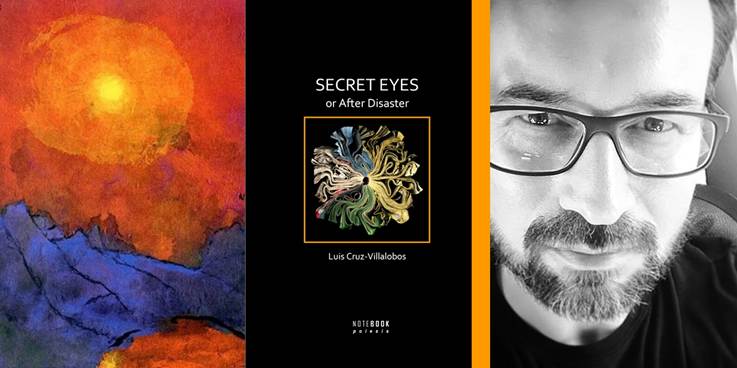
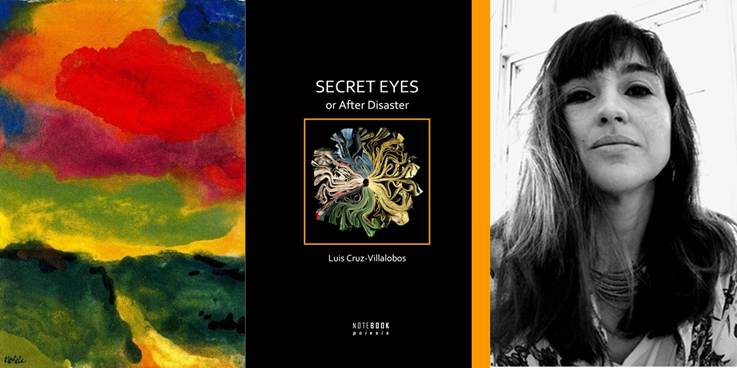
In the open wound of loss—when words falter and silence becomes heavy—poetry rises as an act of resistance and rebirth. Secret Eyes or After the Disaster (NoteBook Poiesis, 2025), the new book by poet and psychotherapist Luis Cruz-Villalobos, is a lyrical journey through the rubble of grief, where language becomes refuge, witness, and seed of transformation. The two opening texts—The Crumbs of Shared Sorrow by Magdalena Biota and Poetizing Post-Traumatic Growth by the author—serve as a dual threshold into this poetic exploration of mourning and hope. Here, trauma is neither hidden nor avoided: it is named, contemplated, and transfigured through art into fertile ground for inner growth. This work is both elegy and resurrection; in it, pain takes form, metaphor becomes compass, and poetry emerges as the sacred vessel through which life, even after disaster, can be rebuilt with beauty and truth.
THE CRUMBS OF SHARED SORROW
Life hurts in farewells, in transitions. The awareness of parting is the origin, the birth of art and poetry. The pain of losing a loved one reveals the language of a dialogue that transcends the boundaries of communication on the plane of material existence. It pours into the deep depths of a symbolism that saves humanity from dissolving its hope into darkness, silence, solitude, ostracism. Creation is the ability to continue bearing witness to the continuity of life.
Existence is mourning. Mourning in the face of each passage. Art is the language, the code, through which a subjectivity builds the channels of communication between two worlds, at the mysterious boundary where love embodies the paradoxical experience of recognition in another being. In that recognition lies the capacity for community and communion among those who grieve.
Secret Eyes by Luis Cruz-Villalobos is an elegiac book, built on the ruins of a safe space. In its lyrical composition, the eyes lamenting death are witnesses to hidden knowledge: faith and hope are revealed in misfortune and deep pain. They become the intangible sacrament of a pilgrim journey through the crumbs of shared sorrow, where we recognize one another and offer companionship, where we cradle each other, where we find nourishment.
The surrender to pain is the ability to let go of the expectations we build to shelter ourselves from immensity. Who we were is the broken mirror of who we are as we craft the mysterious truth behind the name of a death. How does revelation occur? It is the gaze upon a new meaning that revokes the singularity, the identity, between the name and its referent, between the father and the deceased son.
Faith in the gaze that transcends pain becomes a way of continuing to construct prism-like symbols through which to contemplate the complex and multifaceted constellation of existence, rather than a fragment reduced by the impositions of our fear. In the unflinching gaze, the veil becomes a channel of communication with that fraction of heaven we treasure from the very root of the flesh that travels fleetingly through time.
Magdalena Biota, PhD
Buenos Aires, Argentina, Summer, 2025
POETIZING POST-TRAUMATIC GROWTH
There is a creature that is reborn unto itself:
The bird called Phoenix. It does not live on fruit
Nor herbs, but on the tears of incense
And aromatic juices. When it reaches
Its five hundred years, it builds a nest
At the top of a palm tree or the crown
Of an oak. It fills it with spices, grains,
And cinnamon bark, and sits upon it
Until it dies amidst those aromas.
Then, from its body, a small
Phoenix arises, destined to live many more years.
When it has grown, it lifts the nest
And carries its father’s remains to the Temple of the Sun,
Where it lays them on the sacred altars.
—Ovid, Metamorphoses, XV, 391–407
The myth of the phoenix has evolved over time. Originally, as observed in Herodotus (Histories, II, 73), it did not represent a bird of fire nor one reborn from its own death, but rather from the death of its father. It was not difficult to interpret, as Ovid does centuries later, that being born after the father’s death is akin to being reborn from him, from his remains. But what happens when it is the child who dies —as is my case as the author of this book— is there a phoenix then? Can there be rebirth from the remains of a dead child? I believe, in part, there can be. This collection of poems, while not explicitly about specific deaths, seeks to poetically unfold the concept of post-traumatic growth, whose excellent metaphor is the phoenix myth, particularly as it is known today: a bird of fire reborn from its ashes.
The concept of post-traumatic growth emerges in the field of psychology as a response to the devastating impact that intensely adverse events can have on people’s lives. Originally proposed by Richard Tedeschi and Lawrence Calhoun, this concept —related to but distinct from resilience and more recent— refers to the positive development that can arise from struggling with severe adversity. This growth does not imply an absence of suffering or a dismissal of trauma but a difficult and profound transformation leading to a life with greater meaning, closer relationships, a renewed appreciation for existence, a sense of personal strength, and significant spiritual or philosophical changes.
Psychologically, post-traumatic growth does not occur automatically. It is a process that requires active reflection, time, and undoubtedly emotional and social support. Trauma destabilizes fundamental beliefs about the world, oneself, and the future, forcing individuals to rebuild their foundational belief systems or worldview. In this process, the ability to reflect on the experience and create new meaning for the traumatic event and its consequences is crucial. Adaptive coping strategies, such as social support, self-exploration, and emotional expression, have been identified as facilitators of post-traumatic growth.
It is essential to clarify the distinction between resilience and post-traumatic growth. Resilience is the ability to withstand and adapt to trauma while maintaining prior functioning, whereas post-traumatic growth involves a positive transformation arising from reconstructing the trauma’s meaning. While resilience preserves stability, post-traumatic growth generates profound positive changes stemming from the collapse of meaning and stability caused by a traumatic event.
In this context, poetic writing emerges as a psychological and emotional tool that can facilitate this transformation process. By expressing emotions and experiences through words, individuals access a symbolic space that allows them to structure internal chaos. From a neuropsychological perspective, this act involves both emotional regulation and cognitive integration, helping reduce the emotional intensity of trauma while reorganizing internal narratives. Poetry, with its condensed and symbolic nature, offers a unique way to process complex experiences and assign them new meaning.
Writing poetry as part of the post-traumatic growth process also directly impacts self-perception and subsequent resilience. Poetry externalizes trauma and allows individuals to observe it from a safe distance, facilitating detachment from pain and the construction of agency. This creative act fosters a sense of control over emotions and experiences, an essential element in overcoming the debilitating effects of trauma. Furthermore, the use of imagery and metaphor in poetry activates cognitive processes that promote mental and emotional flexibility, aiding reconciliation between the traumatic experience and personal identity.
From the perspective of positive psychology, in which post-traumatic growth is framed, poetic writing not only allows for the expression of pain but also opens doors to exploring values, strengths, and spiritual connections. People who undergo a process of growth after trauma often experience a transformation in their value system and find renewed purpose in their lives. Poetry acts as a catalyst in this process, enabling individuals to connect with their deepest emotions and articulate a renewed sense of existence that transcends the pain and suffering experienced.
Post-traumatic growth and poetic writing share an intrinsic relationship that goes beyond mere emotional expression. Poetry, as an intimate language of inner life, becomes a powerful medium for processing trauma, integrating its impact, and finding transformative meaning in the midst of adversity. It invites us to turn pain into beauty, chaos into order, and loss into an opportunity for inner rebirth.
In this collection of poems, through a pervasive metaphor or foundational allegory, post-traumatic growth is described as the process of facing a seismic event of great magnitude —a mega-earthquake. As a Chilean, I have lived through at least two such significant events (1985: 8.0 Richter and 2010: 8.8 Richter), and I find it an excellent image to represent the arduous process of post-traumatic growth, the reconstruction of vast areas of a country subjected to such natural catastrophes. I hope this text enlightens those who read it and encourages them to imagine a better future beyond trauma, for it is possible.
Luis Cruz-Villalobos, PhD
Andean foothills of Curicó, Chile, Summer, 2025
LIFE HURTS
Everyone’s life hurts
In one way or another
Everyone says so
One way or another
But it’s the eyes
That reveal the drastic secret
We cry quietly
Or we cry open to the sound
Here or there
We always do
For life hurts us all
In one way or another.
TERRIBLE ADVENT
When disaster comes
When it comes running down the stairs
Everything usually stops
There at the instant of collapse
And time is different
And space is also different
Music smells of silence
And the silence is seen in abrupt colors
The heart stops
Or breaks in distant spasms
The world changes
It becomes another
When disaster comes
And sings us its rustic song of origin
The heart migrates
To another untamed land
There we depart with it
And we become shy and old pioneers.
ANOTHER MEANING
What to hope for
Now when the time is clear?
That our wounds
May help others heal
That our tears
May water some barren land
That our sorrows
May lighten another’s heavy burden
That our exile
May give wanderers a home
That our disaster
May hoist some hope
That our death
May hide within its folds
Who knows
Perhaps
A tiny seed
Of a new life
Ready
To multiply
Though it could always be
That it won’t
But we shall always believe
That it might
As long as there is earth
As long as there is sky
As long as disasters
Etch themselves in the center
And life’s horizons persist
We might always believe
It might
It might.
A POSTSCRIPT
Come and see
The remnants of memory
The monuments of past time
speaking to us
Come and sing
For there is still voice and air
And if you wish to cry
Do so here with us
But let us not drown in the night
Of dark solitude
For it is a lie that all
Doors and windows are closed
For we
The many
Have come to build them
Here
Amid fallen walls
Amid weathered partitions
We have also brought bridges
And at the heart of the song
We have managed
To carry with us
Small and simple,
Ready to be filled with hope
A new rainbow
For our secret eyes.
Magdalena Biota is an Argentine writer, poet, and musician. She holds a PhD in Social and Human Sciences from National University of Quilmes, is a certified public translator in English (National University of La Plata), and a specialist in library management (University of Business and Social Sciences). Since 2013, she has coordinated training and outreach activities at the National Scientific and Technical Research Council (CONICET). She is also the author of the books Personas (Croupier, 2015), Ciudad de una lengua (Ediciones en Danza, 2019), and Poética / Poetics (NoteBook Poiesis & Cross-Cultural Communications, 2024).
Luis Cruz-Villalobos is a Chilean writer and psychologist, with postgraduate and specialization in clinical psychology and a PhD in Philosophy from Vrije Universiteit Amsterdam. He is a professor and the author of an extensive literary and academic body of work, translated into several languages and recognized with international awards. He has specialized in the study of post-traumatic coping and applied hermeneutics. Since 1999, he has worked as a psychotherapist and currently teaches psychology of emotions and individual intervention techniques at the Faculty of Psychology, University of Talca.
If you would like to purchase a copy of the book, you may access the following LINK.